
HVAC
Keep Your Cool with an In-Demand Career as an HVAC Technician in San Bernardino
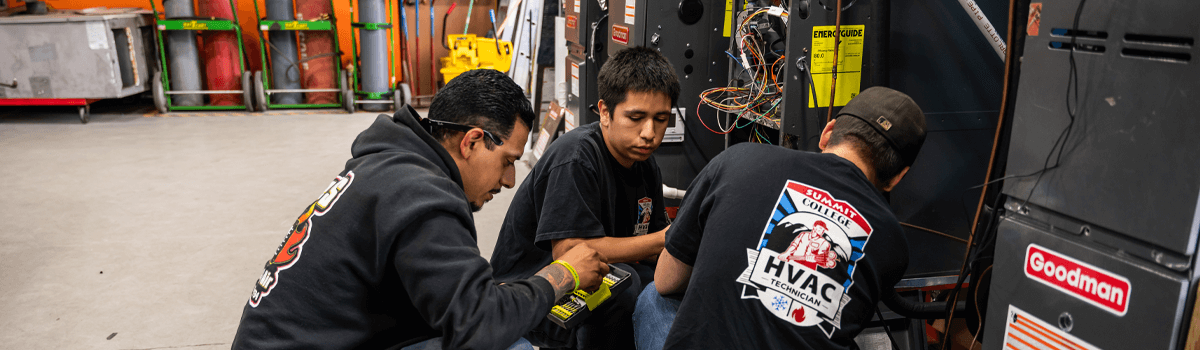
HVAC Training in the Inland Empire
Create a Better Future with Training in HVAC
Heating, ventilation, air conditioning, and refrigeration technicians are responsible for installing, maintaining, and repairing the HVAC/R systems that control the temperature and air quality in our businesses and homes. As our climate continues to shift and change, HVAC technicians will be key to helping us maintain our comfort and quality of living. And because construction is on the rise and many workers are reaching retirement age, the need for HVAC technicians is increasing.
What Does an HVAC Technician Do?
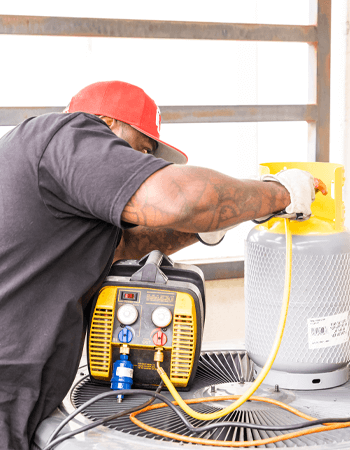
As an HVAC technician, your daily tasks will include things like:
- Installing, cleaning, and maintaining residential and commercial HVAC/R systems
- Installing electrical components and wiring within heating and cooling systems
- Inspecting and testing HVAC/R components and full systems, either as an individual or as part of a team
- Isolating worn or defective parts and repairing or replacing them
- Recommending maintenance to improve system performance or increase the lifespan of system components
- Keep detailed records of the work you perform· Interacting with clients and customers and discussing any issues or system malfunctioning
What Will I Learn in an HVAC Technician Program?
We’ve created our 36-week HVAC program to provide you skilled training on the operations, maintenance, and repair of residential and commercial heating and air conditioning systems. Summit College San Bernardino is focused on the learning objectives that have been identified by HVAC industry groups, like Air Conditioning, Heating and Refrigeration Institute (AHRI) and North American Technician Excellence (NATE).
What will course instruction look like?
The HVAC program at San Bernardino is an on-campus, in-person training curriculum that combines both lecture and lab hours in order to provide you with the best education experience possible. You’ll learn on simulated HVAC training equipment that will help you develop an extensive working knowledge of the operation, maintenance and repair of residential and commercial systems.
Is Career Training Right for You?
Take the Summit College Career Training Readiness Quiz
The fun, online quiz takes 3 minutes to complete, and you’ll get a personalized report. Identify your strengths and social style, plus the training and positions you’re best suited for.
What electrician classes will I take?
Summit College San Bernardino’s HVAC program offers a comprehensive curriculum that includes the following courses:
- Principles of Heat, Energy & Pressure
- Electrical Systems & Components
- HVAC Brazing Techniques
- Green Job Training
- Commercial Environmental Systems
- Commercial Refrigeration
- HVAC System Design
- Residential & Commercial
- Refrigerants & Refrigeration Systems
Are HVAC Careers in Demand in California?
They are, both across the U.S. and in California in particular. The Bureau of Labor Statistics predicts that employment of HVAC mechanics and installers will grow by 8% through 2034, much faster than the average for all occupations, with around 40,000 annual job openings.
When it comes to California, the U.S. Department of Labor’s Projections Central estimates HVAC technician jobs will rise even faster, by 11% through 2032, with around 3,800 job openings on average annually.
Where can HVAC technicians work?
Across Inland Empire, any business or company in need of skilled technicians who can help install and maintain HVAC systems is a potential employer, including:
- Construction companies
- School districts and educational campuses
- HVAC contractors
- Building maintenance services
- Refrigeration services
- Manufacturing plants
HVAC and HVAC/R technicians can also be self-employed and work directly with customers to hire out their skills and services.
What jobs can I get in San Bernardino with training as an HVAC tech?
Here are some of the potential job titles and opportunities:
- Air Conditioning Technician
- Heating, Ventilation, and Air Conditioning Installer
- HVAC Mechanic
- HVAC Service Tech
- HVAC Specialist
- Residential HVAC Tech
- HVAC Sales Representatives
- Solar Technician
San Bernardino Campus
With modern classrooms equipped with audiovisual technology, labs outfitted with updated equipment and instruments, computer labs, and a student lounge, the San Bernardino campus of Summit College is set up to provide a quality education in both our allied health and skilled trades programs. Parking is provided to students at no charge.
Address and Location
Address
804 East Brier Drive
San Bernardino, CA 92408
Located near I-10 and a short walk from the Tippecanoe Metrolink Station, conveniently situated near Colton, Loma Linda, Riverside, and more
Phone Number and Hours
General Business Hours: 8:00 AM to 5:00 PM, Monday – Friday
Phone Number: 888.504.2552
Why Should You Choose Summit College San Bernardino?
If you’re looking for a secure career that is all about helping others, a future as an vocational nurse has all of that and more. Summit College can help you get the education and training you need to get it done! That’s what we’ve been doing since 1991 — helping students just like you follow their dreams of an exciting, fulfilling career as a vocational nurse. With hands-on training from caring instructors who have lived and breathed the life of a vocational nurse in the real world, we’ve got your back all the way across the finish line and beyond.
- Professional faculty focused on your success: Your instructors have all done the job you’re training for and use their experience to prepare you for real-world situations. You’ll develop clinical skills through hands-on learning and benefit from small class sizes.
- Curriculum that provides a broad foundation: In addition to clinical and skills fundamentals, you’ll learn about various specialties, including obstetrics, pharmacology, pediatrics, nutrition and psychology and patient education for a solid foundation.
- Flexible schedules: Choose from day or evening/weekend classes that adapt to your lifestyle and responsibilities. Complete the program in just 12 months (full-time) or 18 months (part-time).
Ready for What’s Next?
Your Path to Success Starts Now!
Frequently Asked Questions
How Do I Become an HVAC Technician in California?
While some people choose to go into an apprenticeship, which means jumping right into on-the-job work under substantial supervision, the fact that it can take several years to advance beyond the role of apprentice can be a turn-off for many.
The alternative is enrolling in an HVAC technician training program like the one offered at Summit College San Bernardino. This path appeals to those who want a structured learning experience that makes the most of their time and resources.
To apply for the HVAC program at Summit, you need to:
- Be 18 years or older
- Provide an acceptable high school diploma, GED, or equivalent
- Complete an interview with an Admissions Advisor
- Meet the required level of proficiency with speaking, reading, writing, and understanding English
What Kinds of Certifications or Licenses Do I Need to Be an HVAC Technician?
As part of the Clean Air Act, the U.S. Environmental Protection Agency requires that any HVAC technician who works with refrigerants must hold the EPA 608 Certification for the equipment that they work on — small appliances, high-pressure appliances, low-pressure appliances, or all types. The HVAC program at Summit College San Bernardino is structured to prepare our students to sit for the EPA 608 Universal Certification.
Beyond that, there are a few different types of contractor licenses through the California Contractors State License Board. If you aim to become a contractor or to be self-employed, you will likely need to sit for licensure exams like:
- C-20 Warm-Air Heating, Ventilating and Air-Conditioning Contractor — A warm-air heating, ventilating and air-conditioning contractor fabricates, installs, maintains, services and repairs warm-air heating systems and water heating heat pumps, complete with warm-air appliances; ventilating systems complete with blowers and plenum chambers; air-conditioning systems complete with air-conditioning unit; and the ducts, registers, flues, humidity and thermostatic controls and air filters in connection with any of these systems. This classification shall include warm-air heating, ventilating and air-conditioning systems which utilize solar energy.
- C-46 Solar Contractor — A solar contractor installs, modifies, maintains, and repairs thermal and photovoltaic solar energy systems. A licensee classified in this section shall not undertake or perform building or construction trades, crafts, or skills, except when required to install a thermal or photovoltaic solar energy system.
C-38 Refrigeration Contractor — A refrigeration contractor constructs, fabricates, erects, installs, maintains, services and repairs refrigerators, refrigerated rooms, and insulated refrigerated spaces, temperature insulation, air-conditioning units, ducts, blowers, registers, humidity and thermostatic controls for the control of air, liquid, and/or gas temperatures below fifty degrees Fahrenheit (50 ), or ten degrees Celsius (10 ).
Is HVAC Physically Demanding?
It can, which can be a big upside for people who hate sitting all day at a computer and prefer to work with their hands. HVAC technicians work both indoors and outdoors, sometimes in cramped spaces or buildings that are exceedingly warm or cold because the system isn’t working. Learning how to appropriately utilize personal protective equipment, like safety goggles and masks, and how to properly lift heavy parts and machinery goes a long way toward preventing injury.
How Long Does It Take to Become an HVAC Technician?
Depending on the school you pick, some programs – like those at community colleges – can take up to a year or even longer. However, at a dedicated trade school like Summit College San Bernardino, we work with many students who can’t wait that long to get started on a new career. That’s why our HVAC program can get you from first class to graduation in just 36 weeks.
How Much Does HVAC Technician School Cost?
Traditional colleges in California can cost upwards of $40,000 per year, a price tag that is out of reach for a lot of people. But, as a comparison, HVAC programs at dedicated trade schools, like the one we offer at Summit College San Bernardino, can cost less than half that number. Summit College also has access to a number of financial aid options to support our students.